
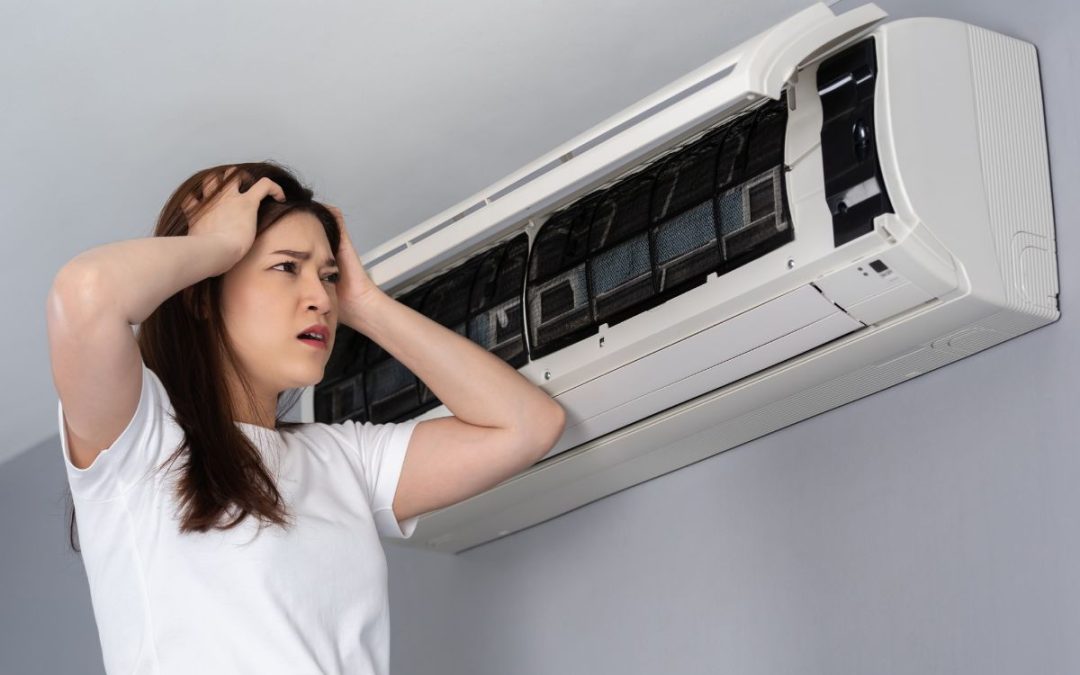
Warm Air Malfunction
It’s frustrating when your Air Conditioner blows warm air, especially during hot weather! An air conditioner not blowing cold air means hot air is coming out instead. While this could be serious, it could be a minor fix. Whatever the case, warmer months in Singapore cause this issue for many households. Repairing it early is the easiest way to ensure it does not become a bigger issue later on.
Blocked Air Filter
One of the common HVAC troubleshooting tips is checking the filters. This beyond-simple task becomes challenging because of a blocked air filter. When the filter gets filled to maximum capacity with dirt, it can no longer capture any dust and dirt; air will not be able to flow smoothly through. This results in your AC overheating. Cleaning or replacing the filter is a simple resolution. Ensuring that the filter is replaced every month is excellent for maintaining efficiency.
Thermostat Settings
In some cases, setting your thermostat will only require a few moments. Ensure it is set to the “Cool” mode and the temperature is lower than the ambient temperature. In addition, make sure the batteries in the thermostat are not low. Weak batteries can interrupt cooling functions and trouble the AC. For your good, always confirm the settings before requesting assistance.
Low Refrigerant Levels
The cooling liquid in your AC is called refrigerant. If there is not enough refrigerant, there will be no cold air. Low refrigerant is often indicative of a leak. You may hear a hissing sound or notice the coils icing over. You cannot resolve this problem on your own. The unit needs to be opened, inspected by a qualified technician, repaired by sealing the leak, and then properly recharged with refrigerant gas. Failure to do this can also compromise the compressor.
Blocked Condenser Unit
The outdoor unit of your device (condenser) ejects heat from inside your room. It cannot function well if dirt, leaves, or other bits and pieces block it. Inner devices will collect ice, making the unit seem hot and no longer cool. Dust the condenser and remove the dust while ensuring that there isn’t any airflow obstruction. Make sure that your fan is smooth and steady without stuttering. This small problem can keep your AC working at its best.
Frozen Evaporator Coils
If the coils are frozen, your AC will stop blowing cold air altogether. It will almost always be one of two things: poor airflow or lack of refrigerant. You likely notice ice forming on the indoor unit. Switch off ACs whenever possible and let the ice melt for hours. Afterwards, it can be done, and filters can be cleaned. You may need a technician if the aircon works fine but does not cool.
Compressor Breakdown
The compressor of your air conditioning unit is responsible for cooling the air in your room. It also manages the flow of refrigerant, which cools the air released by your vents. If the air conditioner’s compressor breaks down, nothing will cool, and you might experience strange noises or issues with the outdoor unit getting powered on. Getting a compressor replaced will set you back a significant amount of money, and you will require a technician’s help. In the case of older ACs, replacing the entire unit is advisable instead of just replacing the compressor.
Electric Problems and Poor Wiring
Your AC’s refrigerant wires could either be too loose or damaged, and as a result, your unit might struggle to power on and provide cooling. You may also find yourself tripping the circuit breaker. Attempts to fix the AC’s electrical system problems are quite hazardous and require the assistance of a licensed technician. For safety matters, do not try to fix the problem yourself and seek the guidance of a certified professional.
Issues with Thermostat Sensors
Your AC has a small sensor that detects the room’s temperature. If this sensor moves or breaks, your AC could start air flushing or shutting off too early, leading to malfunctioning. A pro can check and reposition the sensor; in most cases, this repair is inexpensive.
Improper Unit Size
At times, the condition of the AC may be just fine, but the unit size is too small for the room. When an AC is undersized relative to the area, it fails to cool the room as needed; instead, it only attempts to cool the room and continues to run without the room ever cooling adequately. In such cases, there is no other option but to buy a bigger unit better suited for the specific area. Therefore, certain factors like square footage require consideration before selecting or deciding between options. How well is the area insulated, and how much direct sunlight does the room receive?
High Energy Bills
Poorly insulated rooms do not retain cool air and tend to lose it quickly. This forces the AC to work continuously to keep the room cool, which it fails to do. Check your doors and windows for air leaks, and seal them shut. Make sure to draw the curtains during the daytime. You can use foam seals to fill empty spaces around window and door frames. This enables the AC to cool the room temperature faster and helps to save electricity.
Indoor Unit Drip Water
AC units sometimes cool rooms where the ceiling and walls meet and actively cool the space while extracting moisture. In these cases, the wall or ceiling surrounding the unit can develop water streaks, making the area reek like stagnant water. Besides this, if the air conditioner is blocked and covered with dust, the moisture from the air can get trapped and result in mould growth around the drain hole. Models equipped with safety switches may cease operations if these dust cover portions remain obscured unpredictably.
Professional Help
When your aircon requires refilling, cleaning, or anything basic, it cools down less than it should. It’s time to call a technician. Time is money, and repairs elongate spending, so it is far better to expedite this process even if it saves no time. Without extending time on diagnostics, professionals know where the issue lies and how to approach it with the proper tools and methods.